Why Earth Has Seasons: A Clear Guide to Tilt and Sunlight
Earth’s seasons come mainly from its tilted axis, which changes sunlight angle and day length. Understand opposite hemispheres, solstices and the difference between seasons and weather.

The seasons are a familiar experience with a surprisingly common wrong explanation. Summer does not happen simply because Earth moves closer to the Sun. The central reason is the tilt of Earth's rotational axis. As the planet travels around the Sun, that tilt changes the angle and duration of sunlight received in each hemisphere. Two questions make the idea manageable: how directly does sunlight arrive, and how long does the Sun stay above the horizon?
A tilted planet travels around the Sun
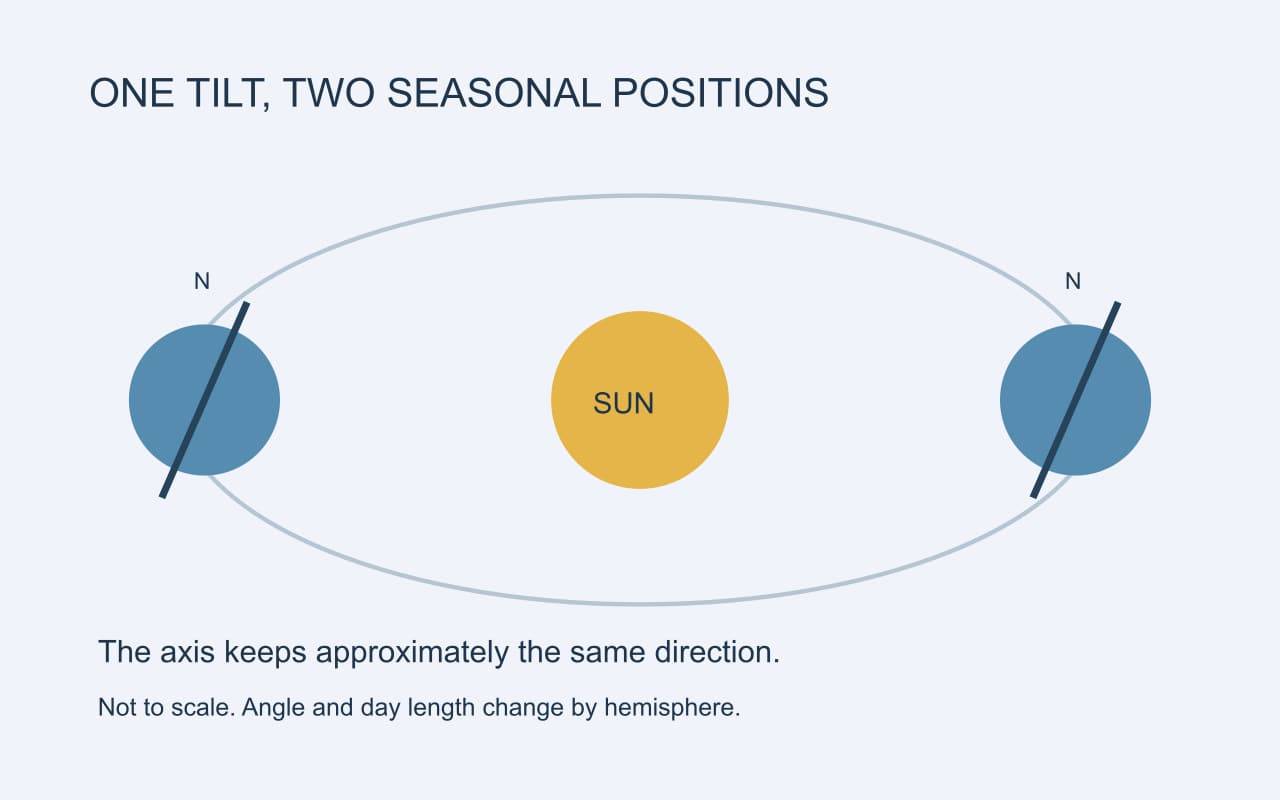
Earth rotates around an axis that is tilted about 23.5 degrees relative to the perpendicular to its orbital plane. NASA's Earth explanations identify this tilt as the cause of the yearly seasonal cycle. The axis keeps approximately the same orientation over the course of one year, so different parts of the orbit place each hemisphere differently with respect to the Sun.
This is easier to picture if you distinguish rotation from orbit. Rotation is the daily turning of Earth. Orbit is the yearly journey around the Sun. The tilt belongs to the axis of that daily rotation, while the changing seasonal relationship emerges during the yearly journey. Mixing the two motions makes a simple idea seem much harder.
Sunlight angle changes how energy is spread
When sunlight arrives more directly, a given amount is concentrated over a smaller area than when it arrives at a slant. The distinction helps explain why the height of the Sun in the sky matters. The same light arriving at a shallow angle is spread across more surface, so the geometry changes the energy received per unit area.
A familiar analogy is a flashlight aimed at a surface. Straight on, its patch is compact; at an angle, the patch stretches out. That model illustrates geometry rather than reproducing all of Earth's atmosphere and climate. Its value is in making the angle visible, not in pretending a tabletop experiment contains the whole seasonal system.
Day length changes the daily total
The duration of daylight also changes through the year, especially away from the equator. A longer day provides more time for incoming sunlight, while a shorter day provides less. This works alongside the changing angle. Considering one without the other leaves an incomplete picture of the seasonal difference.
You can notice the duration without measuring temperature at all. Observe when daylight remains after an ordinary evening activity or how the morning light changes at a consistent waking time. Use reliable local sunrise and sunset information if you want precise times. Never look directly at the Sun to carry out a seasonal observation.
The hemispheres have opposite seasons
When the Northern Hemisphere is tilted toward the Sun, the Southern Hemisphere is tilted away, and the relationship reverses half a year later. This explains why June and December carry different seasonal meanings in different parts of the world. A calendar description that treats one hemisphere's summer as universal can be misleading.
That opposite timing is also a useful test of the distance explanation. Both hemispheres belong to the same planet at the same moment. If being nearer the Sun were the main cause of Earth's seasons, it would not explain one hemisphere experiencing summer while the other experiences winter. The tilt accounts for the difference much more clearly.
Solstices and equinoxes mark the geometry
Solstices mark the seasonal extremes in the hemispheres' orientation toward or away from the Sun. Equinoxes occur between those extremes, when day and night are approximately equal in length. NASA's seasonal imagery shows how the illuminated view of Earth changes at these points during the year.
Approximately matters. The everyday experience of sunrise and sunset includes atmospheric and observational details, so the word equinox should not become a promise of an exact twelve-hour split everywhere. The main idea is the changing geometry of illumination. Exact local daylight times are a separate question best answered by an appropriate astronomical calculation.
Latitude changes the experience
Places near the equator and places near the poles do not experience the same annual changes in daylight. Nor does every place describe its seasons through the same four-part pattern of spring, summer, autumn and winter. Regional rainfall, geography and climate influence how people experience and name the year.
This does not contradict the role of axial tilt. It distinguishes the planet-scale cause from local conditions. A general astronomy explanation tells you why illumination changes, while a local climate account explains how those changes interact with oceans, land and atmospheric patterns in a particular region.
A season is not a weather forecast
A cold summer day or a mild winter afternoon does not invalidate the seasonal cycle. Weather concerns shorter-term conditions; the seasonal explanation concerns a repeating astronomical pattern and its broader consequences. Keep the timescale in view when comparing the two.
Likewise, the exact date of a solstice is not a guarantee of the year's hottest or coldest day. The experience of temperature depends on more than the instant at which a geometric extreme occurs. A calendar marker and a local forecast perform different jobs, even when both appear on the same screen.
The simplest reliable explanation connects the tilted axis to sunlight angle and day length. Once those pieces fit together, opposite hemispheres and the seasonal calendar make much more sense. For another familiar cycle whose explanation is often confused with a shadow, explore why the Moon changes phase throughout the month.